

United Kingdom
Pizza trailers for sale
A pizza trailer for sale here is designed around the oven, because the oven decides the point loads in the floor, the extraction rate above it and the fuel route into it, and none of those can be added later.

An oven is the heaviest thing that will ever sit in the unit and it sits in one place. The frame under it is designed for that load before the floor goes down, and a unit that was not designed for it will tell you so within a season.
Wood, gas and electric each change the extraction, the certification and the service day. The choice is made at the start because it is not reversible afterwards.
What the oven decides
| Point loads | Frame designed for the oven position and the oven mass, before the floor is laid |
|---|---|
| Extraction | Volumetric rate sized to the oven and the rest of the hot line together |
| Fuel | Wood, gas or electric, each with a different certification route in the destination market |
| Gas certification | Where gas is chosen, certified at manufacture for the destination market |
| Prep | Refrigerated prep length set by dough volume rather than by the space that was left |
| Flooring | Sealed and coved, falling to a drain |
The range
Units this is usually built from
Every one is built to an order and configured to the specification agreed with you. Nothing here is stock.
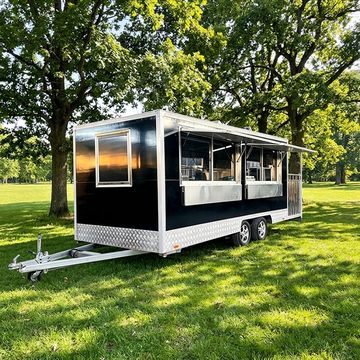
Pizza 400
Built around the oven: reinforced floor, and extraction that carries the heat.
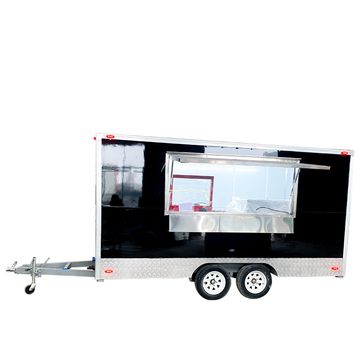
Pizza 500
Oven and grill line side by side, for a two-concept flagship.

Barbecue 400
Solid fuel, serious weight, and a fire plan a market will accept.
Before you pay
The approval route comes first
A unit that cannot be registered where it is going cannot be used there. So the route is established first, in writing, and each country's route is published with the regulator's own source and the date it was read.
Getting it registered in the United Kingdom
Supplying a new category O trailer for road use in Great Britain without a certificate in effect is a criminal offence, and the certificate is an EU Certificate of Conformity, a national small series certificate or an Individual Vehicle Approval certificate. Which route applies to your unit is established in writing before you pay, with the authority and the documents named. The route for United Kingdom, with the regulator's own source and the date it was read.

Questions
Asked before an order, not after
Wood or gas?
Wood changes the extraction and the service day. Gas changes the certification, and in several markets it cannot be certified after the build. Both are buildable and the decision is made before the frame.
Can an oven be added later?
Not safely to a floor that was not designed for it. That is the reason the oven is chosen first.
United Kingdom
What is different here
What is true here and not in Australia. 8 things that decide a specification in this market and do not apply in the other one, each with the instrument or the authority it was read from.
Decides the unit
01Two chapters of the hygiene annex were lifted off a mobile unit. The rest were not
Chapter I of Annex II to Regulation 852/2004 sets the general requirements for food premises and excludes premises specified in Chapter III. Chapter II does the same for rooms where food is prepared. Chapter III, the one written for movable premises, is nine short paragraphs. Nothing lifts Chapters IV to XII, so equipment, food waste, water supply, personal hygiene and training bind a trailer exactly as they bind a restaurant.
What it changes. The brevity of Chapter III reads as permission and is not. The specific obligations that decide a build sit in the chapters that are rarely quoted, which is why the water, the waste and the wash up are settled on the drawing.
Read from Regulation 852/2004, Annex II 2026-09-07
A third of the hygiene rating is the building, and a trailer is the building
The Food Standards Agency describes three elements checked at inspection: how hygienically food is handled, the physical condition of the business including cleanliness, layout, lighting, ventilation and pest control, and how the business manages food safety. To reach the top rating of five a business has to do well in all three. Two of those elements are what people do. The middle one is what was drawn.
What it changes. Layout, lighting, ventilation and pest proofing are decided at the drawing and cannot be recovered by a procedure or a training record afterwards. It is the part of the score a specification actually controls, and the part a used unit hands you already fixed.
Read from Food Hygiene Rating Scheme, guidance for businesses, Food Standards Agency 2026-09-09
Displaying the rating is voluntary in England and required by law in Wales and Northern Ireland
The Food Standards Agency states that a business in Wales is legally required to display its rating in a visible place at or near each customer entrance, and that a business in Northern Ireland is legally required to display it at or near each customer entrance, readable before a customer enters. In England the same page says only that a rating can be displayed. Three nations, one scheme, two different legal duties.
What it changes. On a fixed shop the customer entrance is a door. On a trailer it is the serving hatch, so a unit destined for Cardiff or Belfast needs a flat, visible, washable place for the sticker that is readable with the hatch open, and that is a decision on the drawing rather than a decision on delivery day.
Read from Food Hygiene Rating Scheme, displaying your rating, Food Standards Agency 2026-09-09
Decides the business
04Supplying the trailer without a certificate in effect is a criminal offence, not a paperwork delay
Under the Road Vehicles (Approval) Regulations 2020, supplying a recordable trailer for use on a road without an EU Certificate of Conformity, a national small series certificate or an IVA certificate having effect is an offence. The penalty is an unlimited fine in England and Wales, or up to three months imprisonment for an individual, or both. For a large trailer, defined by unladen weight over 1,020 kg or any semi-trailer built to carry goods, regulation 23 requires the supplier to notify DVSA, provide the pertinent information and obtain consent before supply, and consent is withheld until import VAT and customs duty are paid.
What it changes. It puts the approval route on the critical path rather than beside it. A unit that arrives before its certificate does cannot lawfully be handed over, which is why the route is established before the specification is frozen rather than after the build.
Read from The Road Vehicles (Approval) Regulations 2020 2026-09-08
Decides the operation
05Who may tow it was decided by the year they passed their test
A licence obtained before 1 January 1997 usually carries a combined vehicle and trailer entitlement up to 8,250 kg maximum authorised mass. A licence obtained from that date covers a trailer up to 3,500 kg, which is category BE, and anything heavier needs category C1+E with a provisional licence, a lorry theory test and a practical test. Six of the twenty three units we specify sit exactly on the 3,500 kg line.
What it changes. The plated mass is a licensing decision about the buyer, not only an engineering one about the trailer. It is settled before a specification is frozen, because a unit the buyer cannot tow is of no use to them.
Read from GOV.UK, towing with a car 2026-09-07
Three obligations land on the operator inside 2027, from three departments
The micro firm exemption from workplace recycling separation in England ends on 31 March 2027, and the guidance names construction sites and the contractors' food and packaging waste on them. Martyn's Law can commence from 3 April 2027 at the earliest, after which an event expecting 800 or more becomes a qualifying event carrying the enhanced requirements. The deposit return scheme for England and Northern Ireland starts on 1 October 2027.
What it changes. None of the three asks anything of a trailer, and two of them change what the operator standing in it has to do. Knowing which is which before ordering is worth more than any option on the list.
Read from The obligation timetable, with each instrument and read date 2026-09-09
The deposit scheme names a coffee shop in the exclusions, not in the definition
A groceries retailer under SI 2025/67 is a supermarket, grocery store, convenience store or newsagent. The definition then excludes premises whose main business is takeaway, a coffee shop whether or not food is consumed there, and a hospitality venue such as a bar, restaurant or club. Only a groceries retailer with MRP premises has to operate a return point, and MRP premises exclude a vehicle that is not permanently stationary.
What it changes. The trade is bracing for a reverse vending machine on every counter. What most units will actually need is a deposit charged, an opt-out decision, and two sentences displayed where a customer chooses.
Read from The Deposit Scheme for Drinks Containers Regulations 2025 2026-09-09
Registration is free, cannot be refused, and buys nobody a look at the unit
The Food Standards Agency says a new food business must register with the local authority at least 28 days before trading, that registration is free, and that it cannot be refused. A business operating in more than one location registers each premises with the authority that premises sits in. There is no application to approve, no plan to submit and no inspection before the doors open.
What it changes. Nobody official looks at the build before it trades, so the first time the unit is assessed it is already serving customers and the assessment becomes a public score. Everything structural has to be right on day one, because nothing checks it before then.
Read from Getting ready to start your food business, Food Standards Agency 2026-09-09
Specify a pizza trailer
Oven type, covers at peak and where it will trade.