

Reference
The deposit return scheme, for a unit with a serving counter
Almost no mobile unit has to operate a return point. Most that sell a can or a plastic bottle will have to charge a deposit, most of those can decide not to, and the ones that decide not to have to put up a sign. That is the whole of it, and it is a long way from the reverse vending machine the trade is bracing for.
The scheme starts on 2027-10-01. What follows is 5 questions in the order that decides it, each answered from the paragraph named beside it.
Read from The Deposit Scheme for Drinks Containers (England and Northern Ireland) Regulations 2025, SI 2025/67: Regulation 1, citation and commencement read 2026-09-08 · Regulation 4, meaning of a deposit item read 2026-09-09 · Regulation 8, general interpretation read 2026-09-09 · Regulation 28, requirement to charge a deposit read 2026-09-09 · Regulation 29, information at opted-out premises read 2026-09-09 · Regulation 34, mandatory return points read 2026-09-09. It is not legal advice.
5 questions
In the order that decides it
Stop at the first no. If you are not a groceries retailer, regulation 34 never reaches you and the return point question does not arise.
Is the drink you sell even in scope?
Regulations 4 and 8A deposit item is a container drink other than a registered low volume product, and a container drink is a drink in a securely closed container. A container is a bottle or can, including its label and its closure, made wholly or mainly of aluminium, PET plastic or steel, holding at least 150 millilitres and no more than three litres, and likely to be used only once or for a short time before being discarded.
So. A canned soft drink and a PET bottle are in. A glass bottle is not, because glass is not an in-scope material. A coffee in a paper cup with a lid is not a bottle or a can. A keg is over three litres. Read your own drinks list against those four tests first.
Are you a groceries retailer?
Regulation 8A groceries retailer is a supermarket of any size, a grocery store, a convenience store or a newsagent. The definition then excludes three things by name: premises whose main business is selling prepared food for consumption off the premises as part of a takeaway service, a coffee shop whether or not it sells food and drink consumed on the premises, and a hospitality venue such as a bar, restaurant or club selling for consumption on the premises.
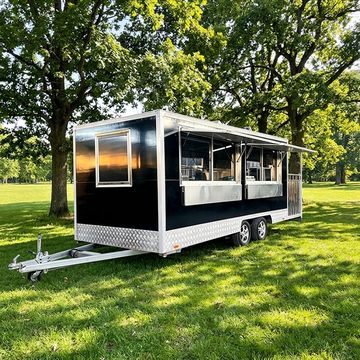
So. A food trailer, a coffee trailer and a mobile bar are each named in the exclusions rather than in the definition. If you are not a groceries retailer, regulation 34 does not reach you at all and there is no return point question to answer.
If you were one, would your pitch be MRP premises?
Regulation 8MRP premises means premises at, on or from which the retailer sells groceries to consumers, other than three things: a motor vehicle, ship or boat, train, tram, aircraft or hovercraft, in each case provided it is not permanently stationary; premises selling only through a vending machine; and on-sale premises.
So. A trailer that moves is not a permanently stationary anything. Whether a drawbar trailer is a motor vehicle for this purpose is not obvious on the face of the instrument, and a unit that has stood on the same pitch for three years is a different question again. Both are worth asking before assuming the exclusion applies.
Must you charge a deposit?
Regulation 28(1) and 28(2)A scheme supplier must charge a customer a deposit for each deposit item supplied. But a scheme supplier who supplies deposit items for immediate consumption at or on any mixed retail or on-sale premises may decide not to charge a deposit for those items. That is an opt-out decision, and it can be reversed at any time.
So. On-sale premises means premises where deposit items are supplied only for consumption there. Mixed retail means both there and away. A serving counter is one or the other, which is what puts the opt-out within reach of almost every unit.
If you opt out, what do you have to do?
Regulation 29Display the opt-out information clearly and accessibly, so it is available to people choosing items for immediate consumption. The information is two statements: that you are not required to charge a deposit on items supplied for immediate consumption here, and a request that empty containers are not removed from the premises.
So. That is a sign, in a place a customer reads before they choose. On a unit with two square metres of counter, where it goes is a specification question rather than an afterthought.
The unit
What it asks of the unit
| Somewhere to display two statements | Legible at the point a customer is choosing, which on a serving counter is the fascia or the hatch rather than a laminated card by the till. |
|---|---|
| If you do not opt out, somewhere for the deposit | Charging a deposit means handling a refund, and a refund means either a return point you are not required to run or a customer who takes the container away. Deciding which is a trading decision, and it has a physical answer on a counter this size. |
| Nothing else | There is no equipment, no certificate and no specification the scheme asks of a trailer. The obligations sit on the retailer and the producer, not on the box. |
Not covered here
Three things, and one of them matters
A registered low volume product is outside the definition of a deposit item, and the registration machinery in Part 4 Chapter 2 has not been read here. It matters to a producer rather than to a counter, but it is why the definition above says other than a registered low volume product.
The exemption route. Regulation 35 exempts small groceries retailers in urban areas and Schedule 3 carries the exemption machinery, including applications ongoing on 1 October 2027. Neither has been read here, and neither reaches a business that was never a groceries retailer.
These regulations cover England and Northern Ireland. Scotland and Wales run their own schemes, and Wales made its own regulations in 2026.
Where this sits
One of three obligations landing in 2027
The deposit scheme starts on 1 October 2027. The micro firm exemption from workplace recycling separation ends on 31 March 2027, and Martyn's Law can commence from 3 April 2027 at the earliest. Three departments, three instruments, one operator, one year. The timetable holds all of them with the date each binds.
Citing this
MODUWRIGHT. "The deposit return scheme, for a unit with a serving counter." Read 2026-09-09. http://127.0.0.1:8812/deposit-return-mobile-units
Free to quote, reproduce or set as reading, in whole or in part, on one condition: name the source and link to it. If a row is wrong, tell us and it is corrected.
Set this as an exercise
Environmental health, hospitality business, sustainability- Regulation 8 defines a groceries retailer and then excludes a coffee shop and a hospitality venue by name. Explain what work those exclusions are doing, and name one kind of mobile drinks seller that is arguably still inside the definition.
- A trailer is not permanently stationary and is arguably not a motor vehicle. Both matter to the MRP premises definition. Argue the case each way and say what evidence would settle it.
- Regulation 28(2) lets a supplier for immediate consumption decide not to charge a deposit, and regulation 29 then requires a sign asking that empty containers are not removed. Explain what problem that pair is solving and what happens to the container.
Free to set as coursework, print, adapt or put on a slide, on one condition: name the source and link to it. What else is free to teach from.